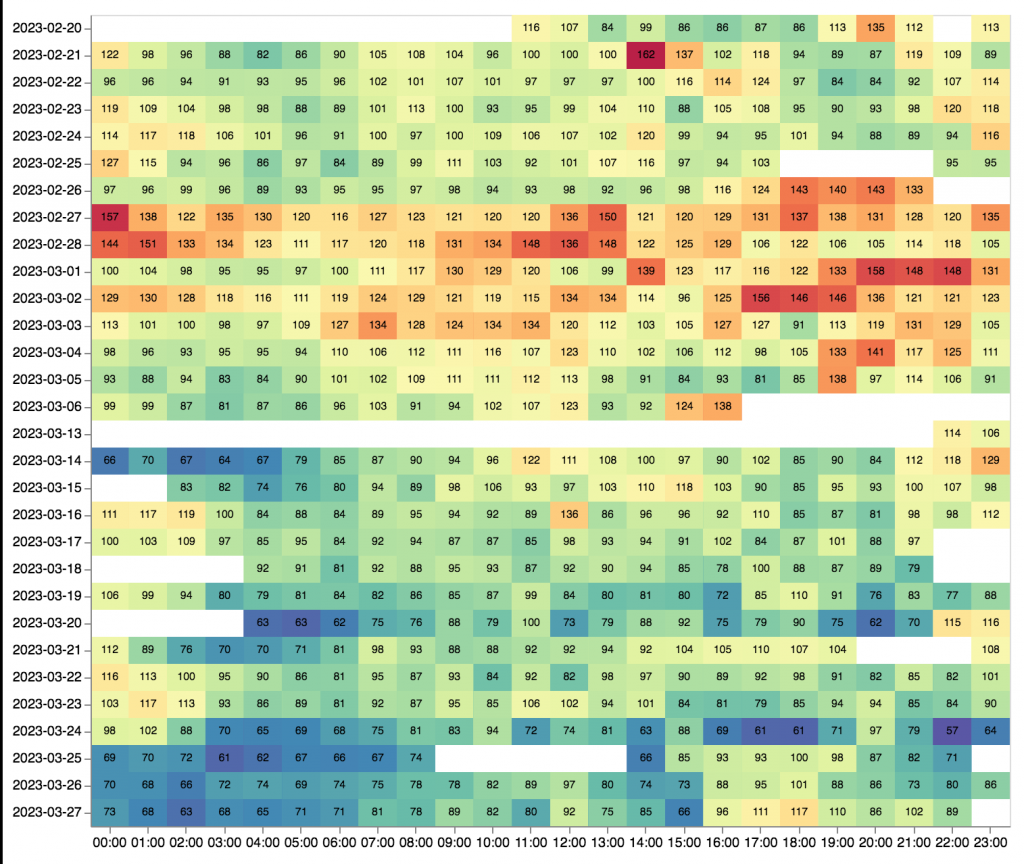
Doug Kanter has been a Type 1 diabetic for 26 years. Through this time he’s come to learn more about his disease by using many data-gathering tools and his own work in visual analysis at the NYU ITP program. We’ve featured Doug’s compelling work here on the blog before and we were excited to hear him talk at the NY QS Meetup about his new project to understand how marathon training and running effect his blood sugar and insulin treatment.
Doug Kanter on Data, Diabetes, and Marathon Training
Introducing the Scanadu Scout
Scanadu, a valued annual sponsor of the Quantified Self, has some important news to share. Check out the announcement below about their recently launched Indiegogo campaign.
—
Sapere Aude. Dare to know
Whether you’re a Quantified Selfer, life-logger, Maker, medical student, techie, MD, parent with kids, parent with parents, teacher, educator, baby boomer, data scientist, pilot, mountaineer, athlete or mathlete, Scanadu Scout™ will medically empower you. Who’s the “first responder” when your vital signs are in flux? You!
Yes! We are the last generation to know so little about our health.
What is the Scanadu Scout™?
Scanadu Scout™ is designed to be a medical grade Tricorder using your smartphone and Bluetooth LE that emulates an Emergency Room in your pocket. It can read your heart rate, skin temperature, core body temp, SPO2, respiratory rate, blood pressure, ECG, and emotional stress. Simply place the scout on your forehead for 10 seconds and snap, your stats are displayed on your smartphone.
With strong feedback from the community, partners, and regulators, and a strong push from Scanadu’s engineers and researchers, the company has made three key breakthroughs:

- Scout others as well as yourself: Just like Mr. Spock, you can now Scout someone else – an ailing parent or sick child. With this breakthrough, Scanadu made some key changes to the design. It is now circular in shape, with the sensors built into the front of the device.
- Make your health feed accessible from a one-stop-shop: You’ll be able to collect readings from Scanadu’s suite of products – including Project ScanaFlo – through one integrated app. Seeing your comprehensive health feed allows for data fusion, and the potential to read more vitals such as cuff less, non-invasive blood pressure. Scanadu Scout supporters will receive free paddles.
- Increased the computational power of the device: Scanadu has added more horsepower to the device, taking it from 8 bytes (the power of an Apple II) to 32 bytes (the power of a smartphone). The new device is built on Micrium, NASA’s real-time operation system for SAM (Sample Analysis at Mars) on the Rover Curiosity.
Where are We in Development?
We have a prototype device that is designed to be an exploratory tool, to interface with medical accessories to measure vitals signs and reagents.
Scanadu Scout™ is not yet FDA approved, and hence it is not a medical device and makes no medical claims. However, to bring the Scanadu Scout™ to the vast consumer market, we still have to file with the FDA. Right now we are giving access to our first version as an exploratory tool, where you and your community are the researchers! By helping us collect future data, we can file our application to the FDA for market approval for an over-the-counter consumer-grade diagnostic tool. As a research tool, the product will not pose any risk to users and can be used to collect, store and display all your information, but without making specific disease diagnoses.
Scanadu will also be offering an early bird special of $149 for the device to the first 1,000 participants. Additional units will be made available at the anticipated retail price of $199. And of course very cool perks for Bodyhackers, Quantified Selfers, Makers, Bio Trekkies and Citizen Doctors! We manufacture in the USA, shipping is worldwide and planned for Q1 2014, and if we ‘re early, it will be a nice surprise:-)
How to Download Your Zeo Data

If you’re a loyal, or even infrequent user of the Zeo sleep tracking device then you’ve probably heard the sad news that the company has shut down. This opens up a lot of questions about what is means to make consumer devices in this day and age, but rather than focus on those issues we’ld like to talk a bit about data.
Zeo has been unfortunately a little quiet on the communication front and there are quite a few users out there who are wondering about what will happen to all those restless nights and sound sleeps that were captured by their device. This has been compounded by the fact that the Zeo website went down for a short time (it is up as of this writing) closing off access to user accounts and the data therein. Lucky for you there have been quite a few enterprising and enthusiastic individuals who have taken the time to create or highlight ways to capture and store your Zeo data.
Use The Zeo Website
You can’t fault Zeo with making it hard to access your own data. As long as their website is up you can easily download your sleep data from by logging into your user account at mysleep.myzeo.com. After logging into your account you will see a link on the right hand side labeled “Export Data.” Click that link and you’ll be able to download a CSV file containing all your sleep data. They’ve even provided a description of the data and formats that you can download here.
Eric Blue’s FreeMyZeo Data Exporter
QS Los Angeles Meetup Organizer and hacker extraordinaire whipped up a simple data export tool using the Zeo API. The great thing about Eric’s is that even if the myZeo web portal goes down this tool should continue to work.
Download Data Directly From the Device
If you’re using a Zeo bedside device then you can continue to use it and download the data directly from the memory card without relying on uploading it to the Zeo website. In order to do this you’ll have to read the documentation and use the Data Decoder Library. These files are hard to find as they’ve been removed from the Zeo developer website, but you can access them from our Forum thanks to our friend Dan Dascalesu. Zeo also created a viewer using this library that you can use via this Sourceforge page.
If you’ve found another way to download Zeo data please let us know. You can also participate in the great forum discussion that inspired this post.
The 2013 Quantified Self Europe Conference Roundup
This past weekend we hosted the 2013 Quantified Self Europe Conference. Over 275 self-trackers, toolmakers, scientists, and enthusiasts came together to collaboratively learn about creating “self knowledge through numbers.” It was an amazing conference that featured over 100 different presentations that included insightful show&tell talks, thoughtful breakout discussions, rapid-fire Ignite talks, and inspirational plenary presentations.
We’re currently processing all the videos from the conference and will be posting those soon. Until then we thought it would be nice to highlight all the great posts, videos, and pictures that our community has been putting together to document their QS Europe Conference experience.
Blog Posts:
Don’t Life Log Me: Quantified Self 2013 in Amsterdam by Hans De Zwart.
The Great Memoto Experiment & Quantified Self Conference Recap by Kitty Ireland.
The Missing Trackers & You, Me, Them: Who is the Quantified Self by Whitney Erin Boesel
Quantified Self Europe 2013 by Winslow Strong
The Quantified Self by Joerg Blumtritt
Quantified Self Europe 2013 Amsterdam by Yago Veith
Dreamboard at the QS Conference Europe 2013 by The Dreamboard Team
Memoto at the Quantified Self Europe 2013 by Niclas Johansson
See your self in Quantified Self Europe by Ian Forrester
Looking back on the QS Europe Conference by Iskander Smit
Intimacy, Innovation and Emotion: My 1st day at Quantified Self Europe 2013 by Clement Charles
Quantified Self Conference Europe 2013 & breathing_time at the Quantified Self Conference by Danielle Roberts
My Learning from the Quantified Self Conference by Oliver Kozak
5 Major Takeaways from the the Quantified Self Conference in Amsterdam by Mark Moschel
Videos:
Our conference videos from the many different Show&Tell talks and our Plenary presentations are coming online. Look out for them on the conference video page.
In collaboration with Fast Moving Targets a few of our conference attendees were able to share their self-tracking stories and thoughts on Quantified Self:
Mikko Ikola: Soylent is a healthy menu of olive oil, pills and powders
David Reeves (Limeade): Self improvement leads to a happier workforce
Joshua Kauffman on Quantified Self, the movement and the trends
Winslow Strong: You don’t need to rely on a doctor anymore for measuring
David Hume (Discipline X Games): We make weight loss the rock n roll for middle aged men
Fu-Chieh Hsu (TrueSense Kit): Our brain is the most complex thing in the universe
Danielle Roberts: The focus in my art is on creating awareness.
Teemu Arina: Sharing data with a community is very motivating
Gustaf Kranck: I want to solve the mistery of the mind
Oliver Kozak: The joy of Quantified Self is learning about yourself
Giorgo Baresi (In The Flow): Now is the time to make Quantified Self mainstream
Ian Li (Google): Knowing the problem is the first step in fixing a problem
Yuri van Geest: We are at a Gutenberg moment of healthcare
Mark Leavitt: Data has power because it tells you a story
Nell Watson (Poikos): More data means more informed choices
Mark Kramer (Razorfish Healthware): Quantified Self improves communication
Ian Forrester (BBC): We research how personal data and storytelling can be combined
Daniel Gartenberg: 76% of people track something. At the moment I track my mood.
Hind Hobeika (Instabeat):Quantified Self can definitely be for everyone
Stuart Calimport: Aging can be overcome
Memoto logs your life in pictures
Photos:
We had some amazing photographers among our attendees who have graciously placed their beautiful images in the 2013 Quantified Self Europe Flickr Group.
Also, check out these awesome mind maps from Wimme Klaver!
Thanks to everyone who participated, volunteered, spoke, shared, and made our conference an experience to remember. We can’t wait to see you all again!
Header image mashup courtesy of Sara Marie Watson, Yago Veith, Ian Forrester, and Rain Ashford
Day One at the 2013 Quantified Self European Conference

This weekend we’re hosting over 275 wonderful people at the 2013 Quantified Self European Conference. So far it’s been an amazing gathering chock full on interesting talks, great conversations, and thoughtful discussion. There’s too much happening to properly summarize it all here, but we thought we’ld give you a little tast of what’s going on.
In collaboration with Fast Moving Targets a few of our conference attendees have been able to share their self-tracking stories and why they’re here.
Hans De Zwart has done a great job capturing his experience by somehow finding the time to write up a wonderfully detailed blog post on his first day at the conference. You can read that here.
Make sure to follow along with what’s going on by checking on the very active conference Twitter stream here.
Announcing the 2013 Quantified Self Europe Conference Program
We are only a few short days away from the Quantified Self Europe 2013. These past few months have been a whirlwind of planning and organizing for all of us at QS Labs. This conference is programmed as a “carefully curated unconference.” That means that all of our sessions come from the conference attendees. We are happy to announce that we have more than 90 separate talks and discussions planned. This means that more than 30% of the attendees will be presenting in some way!
Feel free to browse our schedule and breakout sessions or download a copy of the full program[pdf]. We’ll be posting videos and notes from the conference in the coming weeks so make sure to check back here!
Fun With Sparktweets
It’s no secret we love data here at Quantified Self, but we also love seeing how people interact with data. We’ve explored many of those interactions here and we’re always on the lookout for new and different ways people communicate their data and the insights therein. A few weeks ago we wrote up a short “how to” post describing a recent phenomenon on Twitter – sparktweets. It didn’t take too long before we started seeing the Quantified Self community using these new “data words.”
Got a @fitbit for my birthday. Here’s a week’s worth of daily steps; largest bar is 18k/day: ▆ ▅ ▇ ▅ ▆ ▇ █ (Thanks @e_ramirez).
— P.G. Holder (@pat_holder) April 16, 2013
My photos taken since 2003, broken down by year: ▁▃▄█▄▄▄▁▁▂▄▁ #sparktweet (h/t @e_ramirez quantifiedself.com/2013/04/how-to…)
— Benny Wong (@bdotdub) April 14, 2013
We couldn’t stop thinking about sparktweets. What kind of data could you communicate in 140 characters? What would people do if it was easier to make a sparktweet? So we asked out friend Stan James to help us out and our Sparktweet Tool was born. Since then we’ve seen some great tweets roll though our feed, and we would love to see more. Need some inspiration? Here’s a few we really enjoyed:
▄▃▄▃█▁█▁█▁█ My heart when I walked up to her door, 13 years ago today. (quantifiedself.com/sparktweet-too…)
— Gary Wolf (@agaricus) April 30, 2013
▁█▃▁▁█▅ My @rescuetime productivity score for the past week #sparktweet
— Robby Macdonell (@robby1066) May 1, 2013
▂▃▃▂▂▁▁▂▂▂▃▃▄▄▆▅▄█▇▃▃▃▂▃█▂▁▂▃ My sleep graph, made with: quantifiedself.com/sparktweet-too… #sparktweet #quantifiedself
— Martin Putniorz (@sputnikus) May 2, 2013
▅▂▁▁▅▄▂▁▁▄▆█▆▇▅▄▄▁▁▁▆▂▅▄▁▂▆▄▂▆▃ My activity trend for previous month, made with: quantifiedself.com/sparktweet-too… #sparktweet #quantifiedself
— BuildingIoT (@BuildingIoT) May 2, 2013
What kind of conversation can you start with you data? Head on over to our Sparktweet Tool then make sure to add a link to your tweet in the comments or add to our conversation on the forum.
European Conference Preview: Breakout Sessions
At its core, Quantified Self is a community-driven effort to extract personal meaning from personal data. Our conferences reflect that by providing opportunities to learn what others are doing in their Quantified Self practice. Through our Show & Tell presentations you get to see first-hand accounts of how data is being collected and put to use in order to understand and investigate personal phenomena, but that’s not all our conference have to offer. In the spirit of collaborative learning we also schedule “Breakout Sessions” alongside our wonderful Show & Tell talks. These sessions, like all our conference programming, are developed and and facilitated by our wonderful attendees. Here’s a preview of just a few of the many fantastic Breakouts we have scheduled.
Title: The Self in Data
Breakout Leader: Sara Watson
Description: In my research on the QS community, I’ve found that we talk a lot about our technical requirements of data, and about how we want to use data. What we don’t often talk about is what it means to know ourselves through data. This breakout is an opportunity to discuss what data tells us about ourselves and how we relate to our data.
Title: On Sleep Tracking
Breakout Leader: Christel De Maeyer
Description: Does self-monitoring with devices like myZeo, Body Media create enough awareness and persuasion to change behavior and to maintain new habits? We would like to use this session to learn and share our experiences.
Title: Tracking breathing as a Unifying Experience
Breakout Leader: Danielle Roberts
Description: During this session we can exchange experiences on the tracking of respiration and tracking and visualising of life group data in general. You’ll have the opportunity to take part in a demo using custom breath tracking wearables and real time visualisation of breath data.
Title: Activity trackers
Breakout Leader: Michael Kazarnowicz
Description: We’ll take a look at the most common activity trackers on the market today. We will look at the trackers (maybe even play around with them hands-on) and compare the functions and the data you can get from them.
Title: QS as a Catalyst for Learning?
Breakout Leader: Hans de Zwart
Description: In this session we will explore whether quantifying yourself can act as a catalyst for learning. Can it speed up the learning process? Can it help us in achieving the holy grail of learning, a personalized tutor? What perverse effects might it have in the context of learning?
The Quantified Self European Conference will be held in Amsterdam on May 11th & 12th. Registration is now open. As with all our conferences our speakers are members of the community. We hope to see you there!
What We Are Reading
Here we are again. Another week and another great list of articles, projects, and posts. We hope you find these as interesting as we did.
Data Science of the Facebook World by Stephen Wolfram: “I’ve always been interested in people and the trajectories of their lives. But I’ve never been able to combine that with my interest in science. Until now.” Stephen Wolfram sets his mind and data crunching services and the mounds of data available through the Wolfram|Alpha Personal Analytics service.
There’s an App for That by John-Paul Flintoff: While many people write about QS, every once in a while a piece stands out as a thoughtful and personal assessment of the meaning of self-tracking. The only major fault with the piece is the accompanying illustration which proclaims that “the overexamined life is not worth living,” a conclusion the article does not actually make.
Disciplinary Power, the Oligopticon and Rhizomatic Surveillance in Elite Sports Academies: Elite athletes and sports programs push Quantified Self tools to their extremes. This article from an academic journal about surveillance discusses the tracking mechanisms employed in elite sports academies that transform performance into a type of numerical language that contributes to new social norms, personas and senses of the self
Refugees of the Modern World by Joseph Stromberg: A common cultural signature in the world of the Quantified Self is the formation of loose-knit groups around common interests and conditions. So it was fascinating to learn of a tight-knit group that has formed around the choice of a common environment in which to live. This is the stort of a self-diagnosed group suffering from “electromagnetic hypersensitivity” who live together in an area of West Virginia in the U.S. National Radio Quiet Zone.
Body 01000010011011110110010001111001 by Stanza: Artists have been playing with connecting #quantifiedself and “smart city” technologies for several years. I think projects like this are useful for opening new channels of thought not yet constrained by utility.
Goggles Can Provide Vital Data and Distraction by Matt Ritchel: Google makers incorporate data streams into heads up displays. But why include text messages? That seems like a mistake.
Thanks to Joshua Kauffman and Gary Wolf for contributing to this weeks post! If you’ve found something interesting be sure to send it to us and we can post it in the upcoming weeks.
Cathal Gurrin: Seven Years of Lifelogging
Lifelogging is somewhat of a hot topic these days. With the soft release of Google Glass, the crowdfunding success of personal logging cameras like Memoto, and the release of numerous technology-enabled auto diaries it should be no surprise that Lifelogging is a one of the core themes of our upcoming Quantified Self Europe Conference. We’re looking forward to collaboratively exploring how lifelogging fits into our personal and social contexts and we’re excited to welcome an excellent group of speakers on this topic.
Cathal Gurrin is a lecturer at the School of Computing, at Dublin City University, Ireland and he is an investigator at the CLARITY Centre for Sensor Web Technologies. Cathal is really a ‘hands-on’ researcher, so since June 2006, he has ‘lived his research’ and worn various sensing devices during waking hours. He has amassed a huge archive of 14 million wearable camera photos, weeks of video, sound samples and various other sensors such as location, movement, and nearby people. His research team is exploring how they can develop quantified self and lifelogging technologies that can have positive benefits in the real-world, with an initial focus on personalised healthcare and digital diaries.
One example of this work is the ‘Colour of Life’ wall. The Colour of Life wall is a touchscreen visualisation that plots a two dimensional view of a person’s life experience, in terms of colours encountered (imagine a 1 pixel camera), on a large video display wall. It is captured by wearable cameras configured to take about 2 photos per minute. The interface allows clustering of life events across weeks, months or even years. The colours displayed have a unique meaning to the camera wearer, for example, at a glance at the wall can show time periods when the wearer spent too long in the office or driving to work.
We’re excited to have Cathal at the conference where he will be sharing what he has learned during the last seven years of his personal lifelogging experiment. He will also show some of the new technologies his team are working on and will share his understanding of the likely potential pathways that this work of lifelogging will need to take in order to reach widespread use.
The Quantified Self European Conference will be held in Amsterdam on May 11th & 12th. Registration is now open. As with all our conferences our speakers are members of the community. We hope to see you there!